
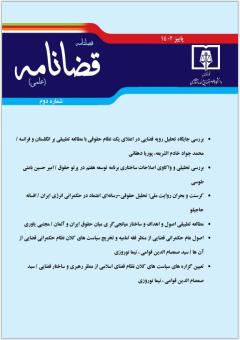

بررسی جایگاه تحلیل رویه قضایی در اعتلای یک نظام حقوقی با مطالعه تطبیقی بر انگلستان و فرانسه
محورهای موضوعی : رویه در فقه و حقوق اسلامیمحمد جواد خادم الشريعه 1 , پوریا دهقانی 2
1 - گروه حقوق و علم قضایی، دانشکده حقوق و علوم قضایی، دانشگاه علوم قضایی و خدمات اداری، تهران، ایران
2 - گروه حقوق و علم قضایی، دانشکده حقوق و علوم قضایی، دانشگاه علوم قضایی و خدمات اداری، تهران، ایران
کلید واژه: رویه قضایی, حقوق ایران, حقوق فرانسه, کامنلا انگلستان, مطالعه تطبیقی,
چکیده مقاله :
رویه قضایی در نظام حقوقی ایران، علیرغم آنکه بهعنوان منبع رسمی حقوق شناخته نمیشود، در عمل نقشی بنیادین در رفع ابهامها، تکمیل خلأهای قانونی و افزایش پیشبینیپذیری تصمیمات قضایی ایفا میکند. این پژوهش با رویکردی تطبیقی، جایگاه و کارکرد رویه قضایی در ایران را با دو نظام برجسته حقوقی یعنی فرانسه (نمونه حقوق نوشته) و انگلستان (نمونه کامنلا) بررسی میکند. در فرانسه، رویه قضایی اگرچه ظاهراً نقش تقنینی ندارد، اما در عمل با تفسیر خلاق و انتزاعی، به تکامل قواعد حقوقی کمک میکند. در مقابل، در انگلستان، نظام کامنلا مبتنی بر قاعده سابقه است و آراء قضایی ستون اصلی شکلگیری قواعد حقوقی به شمار میآیند؛ امری که بیشترین درجه پیش بینی پذیری را فراهم میسازد. یافتهها نشان میدهد که ایران، برای ارتقای کارآمدی نظام حقوقی، نیازمند تقویت نهاد نقد رأی، شفافسازی انتشار آراء و پذیرش نقش عملی رویه قضایی در تفسیر قانون است. مقایسه تطبیقی نشان میدهد که بهرهگیری نظاممند از رویه قضایی میتواند به افزایش انسجام، ارتقای کیفیت آرای دادگاهها و توسعه اعتماد عمومی منجر شود.
Although judicial case law is not formally recognized as an official source of law in the Iranian legal system, it plays a fundamental role in practice by resolving ambiguities, filling legislative gaps, and enhancing the predictability of judicial decisions. Adopting a comparative approach, this study examines the status and function of judicial precedent in Iran alongside two prominent legal systems: France, representing the civil-law tradition, and England, representing the common-law tradition. In France, judicial decisions, despite lacking an explicit legislative function, contribute substantially to the development of legal rules through creative and abstract interpretation. In contrast, in England, the common-law system is built upon the doctrine of precedent, and judicial decisions constitute the primary foundation upon which legal rules are formed—a feature that ensures a high degree of predictability. The findings indicate that Iran, in order to improve the effectiveness of its legal system, must strengthen the institution of judicial opinion critique, increase transparency in the publication of decisions, and acknowledge the practical role of case law in statutory interpretation. The comparative analysis further suggests that systematic engagement with case law can enhance legal coherence, improve the quality of judicial rulings, and foster greater public trust.
Baker, J. H. (2019). An Introduction to English Legal History (5th ed.). Oxford University Press.
Carbonnier, J. (2004). Flexible droit: Pour une sociologie du droit sans rigueur. Paris: LGDJ.
Conseil d’État. (2006). Rapport public: Sécurité juridique et complexité du droit. Paris.
Cour de cassation (Ass. Plén.), 25 February 2000, Costedoat.
Cross, R., & Harris, J. (1991). Precedent in English Law (4th ed.). Clarendon Press.
Dalloz. (2016). “Obligations of Notaries Concerning the Evolution of Case Law.” Dalloz Actualité, Nov. 10, 2016.
Deumier, P. (2014). “The Real State of Case Law in Civil Law Systems: The Example of France.” Revue de l’ERSUMA, Special Issue (IDEF), 47–58.
ECtHR (European Court of Human Rights). (2008). Case law on Legal Certainty and Predictability. Strasbourg.
Elliott, C., & Quinn, F. (2020). English Legal System (18th ed.). Pearson.
Le Goffic, C. (2010). “Jurisprudence and Legal Certainty in French Private Law.” Revue du Notariat, 110, 95–118.
LexisNexis. All England Law Reports (various volumes). London.
Merryman, J. H. (2007). The Civil Law Tradition: An Introduction to the Legal Systems of Europe and Latin America (3rd ed.). Stanford University Press.
Merryman, J. H., & Pérez-Perdomo, R. (2007). The Civil Law Tradition (3rd ed.). Stanford University Press.
Raimbault, P. (2015). “Legal Certainty as an Argumentative Resource in French Case Law.” University of Toulouse, Working Paper.
Simpson, A. W. B. (1986). Legal Theory and Legal History: Essays on the Common Law. Hambledon Press.
Slapper, G., & Kelly, D. (2018). The English Legal System (18th ed.). Routledge.
Stevens, R. (2004). Torts and Rights. Oxford University Press.
Terré, F., & Simler, P. (2011). Droit civil: Les obligations. Dalloz.
The Incorporated Council of Law Reporting. The Law Reports (various volumes). London.
Zander, M. (2015). The Law-Making Process (7th ed.). Hart Publishing.